🩺Introduction
The British Medical Association, or BMA as it is more commonly referred to, has come to define medical practice as we see it today, and continues to play a pivotal role in the experience of being a medical student or a doctor across the United Kingdom. However, many medical students remain unfamiliar with the way in which the BMA operates, and unaware of how and why they should get involved.
In this article we explain why the BMA should matter to you as a medical student, and how you can contribute to the forward-thinking culture, and the journey of positive change, that the BMA cultivates.
We will draw from our own experiences, and the experiences and insights of Rob Tucker, previous Medical Students Committee (MSC) chair, and Elgan Manton-Roseblade, current MSC co-chair, both of whom we spoke to in the writing of this article.
We hope you find the information we provide informative and interesting, and that you feel empowered to be part of the influence behind positive change to the lives of medical students and doctors.
🤔What is the BMA?
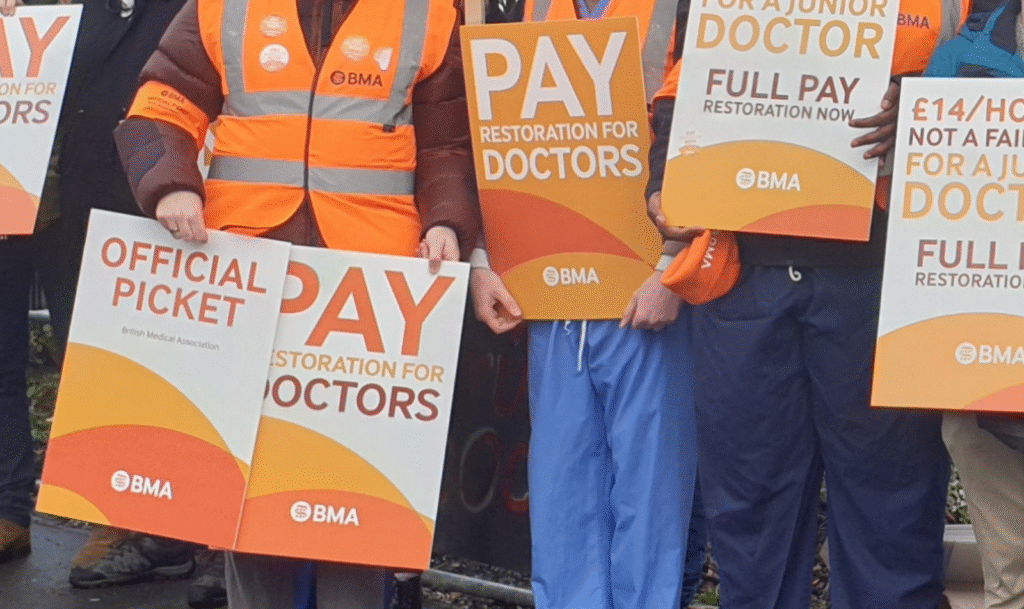
You probably know of the BMA through the media and news coverage of their strike action for doctors pay restoration and better working conditions. A quick googled definition tells you that the BMA is the trade union and professional body for doctors and medical students in the UK. But what does this actually mean? It means that, as a trade union, the BMA represents and supports all UK doctors and medical students when it comes to issues that impact their work-life. These could be issues related to finances, contracts, wellbeing, training, equality, indemnity and much more.
💡The trade union and professional body for doctors and medical students in the UK.
The BMA is also a powerful political voice when it comes to healthcare politics and policy-making, lobbying the government to address healthcare issues, and collaborating with government and GMC officials to determine future policy.
There is a reason that the BMA is able to have such influence over the political landscape when it comes to healthcare. With over 200,000 members, 20,000 of which are medical students, there is power in these numbers, and the BMA abides by the mentality that the collective voice is more powerful than that of the individual.
As a democracy, the voices of every individual are represented when it comes to voting on policy, campaign initiatives, and industrial action. This means for example, that when it comes to striking, a majority of BMA members have voted in favour of taking such action each time.
💡The collective voice is more powerful than that of the individual.
⚕️Why Does the BMA Matter?
A career in medicine is notoriously difficult. With long working hours, many of which are unpaid, high stress environments, diminishing job security, and salaries that do not compensate. It is also a long career, with the challenges and competition starting even before one has applied to medical school, and continuing throughout specialty training.
The medical profession is at risk of exploitation without checks and balances that prevent this from happening. This is where the BMA comes in.
As an organisation that is run by doctors and medical students, for doctors and medical students, the BMA understands the day-to-day work and subsequent challenges that the profession has. By addressing the policies that determine what a working-life looks like for an NHS doctor or medical student, the BMA protects the profession from any violation of their rights.
“But why does the BMA matter to me, a medical student?”
Well, I’m glad you asked. In addition to policy on salaries and doctor’s working hours, the BMA also has policy on tuition fees, funding for medical students, student wellbeing, placement hours, transport to placement, professionalism, sexism, and sexual violence. And this is a non-exhaustive list.
The BMA lobbies medical schools, the GMC, and the government on these issues, protecting students during their time at medical school from unfair or disadvantageous experiences, and advocating for their rights in a range of contexts.
Recent and ongoing BMA campaigns for medical students have included:
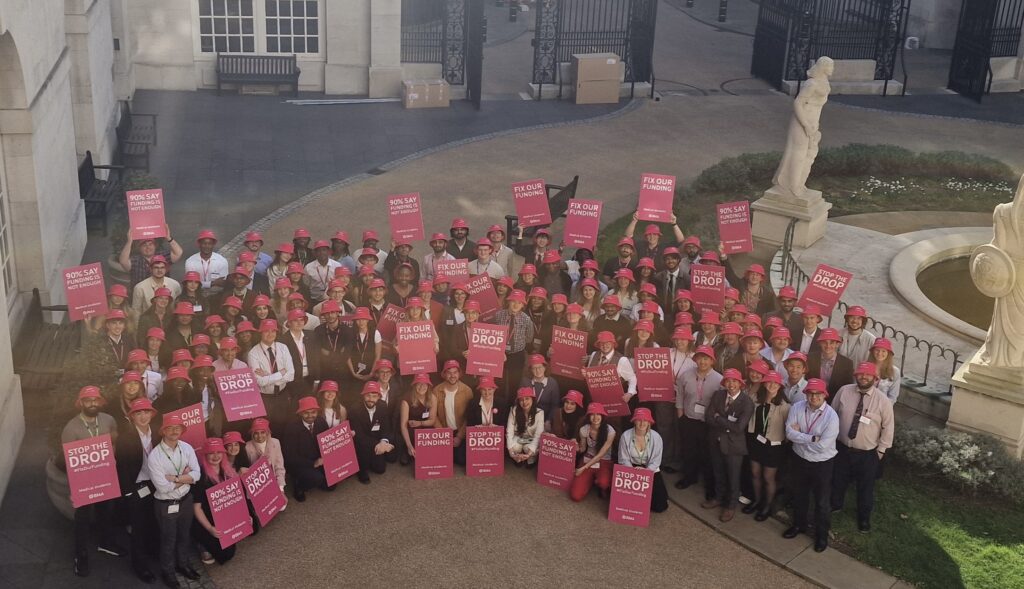
- The ongoing National Funding Campaign, #FixOurFunding, is a response to the inadequate funding for medical students domiciled in England. The campaign is putting pressure on the government to ensure better financial support for students, especially in the last years of study where the replacement of SFE with the NHS bursary means that financial support significantly drops.
- The UKFP Recruitment Campaign addressing the current system of recruitment and allocation to foundation posts which provides medical graduates with little agency over where they will be working in the UK. The campaign advocates for better communication modelling of alternative merit based systems, and the prioritisation of graduates from UK medical schools for FP posts.
- The eye-opening ‘sexism and sexual violence survey towards medical students’ report, which collected data on the student experience. The survey found some shocking statistics, including that 41% of female and 19% of male respondents had been a target of sexual harassment while at medical school.
-
The Student Professionalism Survey that has sought to find out whether student professionalism standards are being misused by medical schools. It will be published early this year, summarising the views of 2.5k medical students.
On an individual level, the BMA can help with personal issues that may be impacting a student’s medical school experience. Please see further information under ‘Asking For Help from the BMA’ below.
✋How Can I Get Involved?
The BMA has committees, meetings, and conferences that its members can be a part of. These committees include the Resident Doctors Committee and the Consultants Committee. There are also committees for certain specialties, and there are regional committees.
Among the many committees within the BMA, there is a medical students committee (MSC). MSC is made up of the MSC Exec who run MSC centrally, and the BMA Student Reps. MSC holds various meetings throughout the year and an annual conference.
As a medical student, you can get involved in a number of ways:
🤝Become a Member!
There are numerous ways to get involved with the BMA. First and foremost, you can become a member!
Membership for first year medical students is free!
For subsequent year medical students, membership costs a few pounds each month.
The main benefit of being a BMA member is the support and protection they provide during your time in medical school and beyond. As a member, the BMA are a point of contact if you have any problems related to finances or wellbeing that are impacting your studies. They can liaise with relevant institutions such as your medical school or the GMC, and negotiate on your behalf. The BMA backing carries a lot of weight and power, so this can be hugely beneficial if you feel you have been unjustly treated.
- There are a number of additional member benefits, including access to the BMJ and other journals, and to the BMA student question bank.
- Access BMA OnExam – an online question bank with thousands of MLA exam-style questions
- Access to the BMA speciality explorer – a tool to help you decide which specialties you might be most suited to
- Access to the BMJ
- Access to a catalogue of e-books and e-journals
- BMA lifestyle discounts
Click here to become a member!
🎓Become a Student Rep!
Every medical school has a BMA Student Representative and a Deputy Rep. Reps play a significant role in local engagement, and with the knowledge that they have of their specific medical school, they are an important point-of-contact for the students there.
Any medical student who is a BMA member can nominate themselves to be a BMA Rep for their medical school. All nominations are then voted on by all BMA members at the medical school. So even if you don’t apply for the rep or deputy rep positions, it remains important that you vote for who will be representing you within the BMA. Nomination and voting happens during April/May each year.
🎤Attend Conferences!
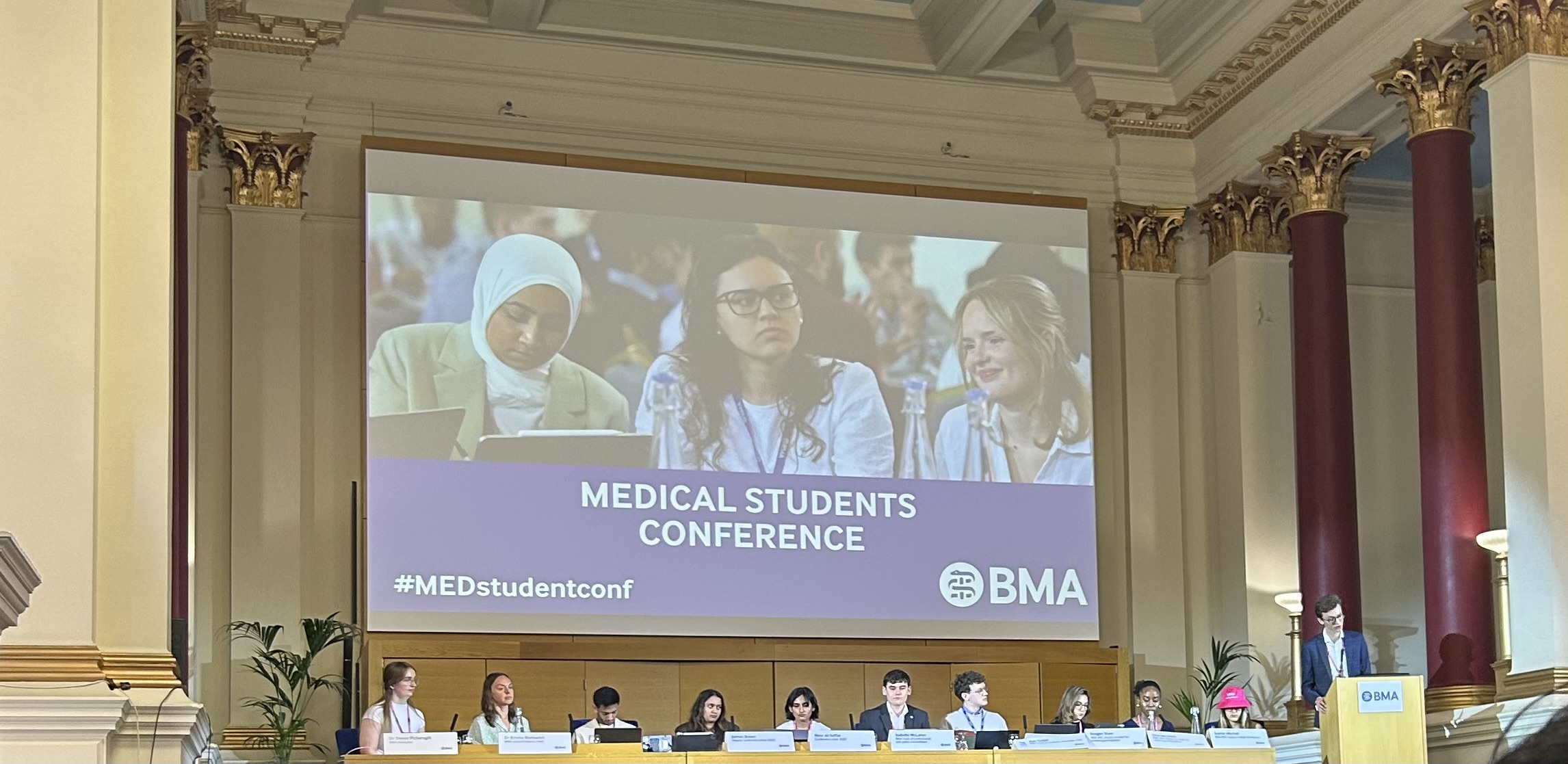
The BMA Medical Students Committee (MSC) hold an annual conference at BMA House in London, around late March / early April. This is a packed two days of speakers, workshops, networking, and voting on motions to decide on BMA policy. It is also worth noting that this is an all-expenses paid trip to London. Delegates (ie conference attendees) stay in a nearby hotel for the night in Bloomsbury.
So how do you attend conference?
All medical students have the opportunity to attend the annual BMA MSC conference:
- Firstly you must be a BMA member. The more members a medical school has, the more students from that medical school may attend conference.
- Then you must write a short motion on an issue that you know is important to medical students at your medical school, or to medical students more widely across the UK. The deadline for motion writing is in December / January. Motions may be on any issue relevant to your experience at medical school, including finances, wellbeing, placements, attendance policies etc. The BMA Rep for your medical school will have further information on how to write a good motion, so we recommend getting in touch with them!
- All students who are BMA members are invited to vote on the motions that were written by students at their medical school. So even if you did not write a motion, it remains important that you vote for the motion you think should go to conference.
- The top three motions attend conference, and depending on how many seats the medical school has at conference, the motion-writers may also attend! Reps automatically get a seat at conference.
- At conference, your motion may be debated and voted on, with the possibility of becoming BMA policy and ultimately making a positive difference to the medical student experience
📝Apply to be on the MSC Exec!
The BMA Medical Students Committee (MSC) Executive is the core team of medical students that run the MSC centrally. They work with local reps to find out about the issues and challenges that affect medical students, and then address these issues by liaising with medical schools, government ministers, and the GMC.
You must be a medical school rep before you can be voted in to be on the BMA MSC Exec team.
- There are a number of different positions on the MSC committee:
- Chair of MSC
- Deputy chair of MSC (education)
- Deputy chair of MSC (finance)
- Deputy chair of MSC (welfare)
- Deputy chair of MSC (widening participation)
- Chair of the medical students conference
- MSC Communications Lead
- MSC Local Engagement Lead
- MSC International Lead
- Student Members elected to BMA Council x3
- Chair of Northern Ireland MSC
- Chair of Scottish MSC
- Chair of Welsh MSC
- Previous Chair of MSC
Each devolved nation has an BMA MSC too; the Scottish Medical Students Committee, the Northern Ireland Medical Students Committee, and the Welsh Medical Students Committee. Each have their own chair and sometimes an executive committee. Often, additional reps are also elected to them directly from their medical schools.
✉️Get in touch!
There are a number of reasons that you might want to get in touch with the BMA as a medical student, and there are a number of ways in which you can do this.
There may be an issue relevant to the medical student experience that you feel strongly about, and wish to address. For example, you may have become aware that there are many medical students who are struggling financially, or who are unable to get to their rural placements, or you may believe that there are inconsistencies in teaching or marking of assessments.
You can find out whether the BMA already has policy on this issue, what work they have done already to address it, and how best you can contribute to making improvements.
There are a few options for getting in contact with the BMA:
- Contact your local medical school reps.
- Directly contact MSC with questions or insights by sending an email to info.students@bma.org.uk
- The BMA advice form can be used for queries, which then go on to be triaged based on urgency.
📞Asking for help from the BMA
In addition to addressing issues that are relevant to all medical students across the country, the BMA can also play a significant role when it comes to the challenges that affect an individual medical student. You may have had a difficult experience on placement, or feel that you have been unfairly treated, or you may be struggling with your mental wellbeing. In any of these scenarios, you can contact the BMA for advice. They may be able to directly help you with the issue, or they may be able to effectively sign-post you to the right people.
There are a number of ways in which you can ask for help from the BMA, including speaking to your local medical school representative who is in direct contact with MSC and can sign-post you to the relevant person, or by filling out the BMA advice form where your query will be triaged and someone will respond as soon as possible.
Additionally, and most importantly, the BMA helpline is open 24/7. This is a confidential and free counselling and peer support service for all doctors and medical students, and is open to non-members as well as members. The number is 0330 123 1245.
📖A Personal Experience
I started to get involved in the BMA during my third year of medical school. I had begun to feel that there were issues that affected the daily lives of medical students that were not seriously addressed by medical schools, and that ensuring the mental wellbeing of medical students had become more of tick-box exercise rather than something medical schools actively took steps to improve.
I was looking for someone to take seriously the medical student experience, to challenge the status quo, and stand up for unfair treatment that had been normalised. And I felt that the BMA did exactly this.
I attended conference during my third year by submitting a motion on disparities in placement opportunities. I thoroughly enjoyed my time at conference. I found like-minded people who cared deeply about the medical school experience, and actively sought to make improvements. I enjoyed networking, and finding out about the similaires and differences between policy and culture at different medical schools across the UK. Some challenges appeared to be national, while others were more unique to my medical school or the area of the country that it is in.
I then applied and became the rep for my medical school the following year, during which I attended my second conference.
Conference delegates have the opportunity, if they want to, to debate on motions important to them. This at first can feel daunting, but at my second conference, I stood at the podium. During my allocated few minutes, I argued for the BMA to vote to put pressure on medical schools to remove their investments from companies associated with weapons manufacturing. Despite feeling very anxious when it comes to public speaking, a fear I know is shared by many of us, I felt so empowered to use my voice, and encouraged along the way, that the experience was a wholly positive one.
I will be attending my third conference, not as a delegate, but as a member of the conference Agenda Committee (AC), meaning that I will be helping to organise and run the event itself.
Getting involved in the BMA gives you the feeling that you are “in the room where it happens”. I have found it an incredibly energising experience to be a part of determining policy that has real-life impact. In addition to feeling involved in making positive change, my roles within the BMA have also had personal benefits: I have greater confidence to verbalise my opinions, and substantially more knowledge of health policy and current affairs.
I encourage all medical students to become familiar with the discourse and policy that shapes their experience of medical school, and the BMA is the perfect place to learn all about it.
🗂️Glossary of Acronyms
AC = Agenda Committee
BMA = British Medical Association
BMJ = British Medical Journal
GMC = General Medical Council
MLA = Medical Licensing Assessment
MSC = Medical Students Committee
NHS = National Health Service
SFE = Student Finance England
UKFP = United Kingdom Foundation Programme
📚Resources
- BMA Website Link
Instagram:
The BMA instagram accounts post regular updates regarding campaigns and events that medical students can get involved in.
- Main BMA accounts: @thebma
- BMA Student account: @bma.students
- Also see your medical school-specific BMA instagram account. The BMA student instagram account has a pinned post detailing the instagram handles of every medical school in the UK.
Thanks for reading! If you have any comments or suggestions, please feel free to share them below and we’ll get back to you as soon as we can!