

For many medical students thinking about foundation training, the information surrounding the Specialised Foundation Programme (SFP) can be confusing and even intimidating. Is it only for future professors? Do you need a list of publications to stand a chance? Will you miss out on clinical time?
This article breaks down what the SFP actually is, the application process, and how to decide if it’s right for you.
🤔What is the SFP?
The Specialised Foundation Programme (SFP) is a competitive foundation training programme that runs in parallel with the standard Foundation Programme (FP). It is the same length and provides the same training as the FP, allowing you to still progress as a junior doctor. The difference is that SFP trainees are given protected time to work on projects in a specialised area within:
- 📝Medical Education
- 🔬Academic Research
- 💎Management and Medical Leadership
This alternative pathway provides an opportunity to develop skills in these areas alongside clinical training.
📌What to expect as an SFP Doctor
There are 18 deaneries based around regions in the UK, and the structure of SFPs are determined by each deanery.
To get the most up to date information about a specific deanery, it is always best to check the information for postgraduates on that particular website. While the structure may differ, in every SFP post you can expect the academic work to involve one or more of:
- Contributing to a research study or audit
- Designing and delivering teaching for students
- Taking on a leadership or management project
Every SFP trainee is allocated an academic supervisor to guide academic work and provide feedback. Throughout, you still rotate through clinical jobs and are expected to gain the same foundation competencies as your colleagues.
⚠️Therefore, it is important to note that you will have less time to achieve the same clinical objectives as the standard FP programme.
⏳Programme structure
The standard FP structure is that the two years are split into six four month clinical rotations.
In the SFP, the majority of deaneries offer one of these four month blocks – usually in the F2 year – as dedicated academic time, in which you have no fixed clinical commitments or on-call duties.
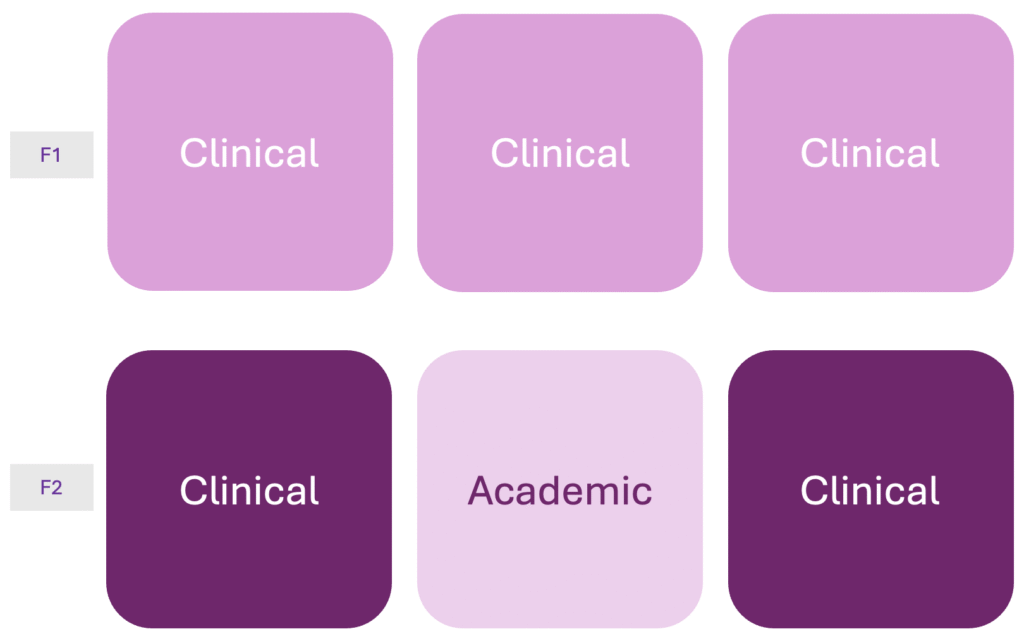
✅Advantage of this structure:
- Good amount of time to work on a project and get something underway without the pressure of any clinical work
❌Disadvantages:
- Projects longer than four months are difficult to manage
- May lose some clinical skills in the four month academic period
Another format is still having a dedicated four month block, but with day releases. This means that during the clinical blocks, one day per week is dedicated to academic work, and during the academic block one day per week is dedicated to clinical work.
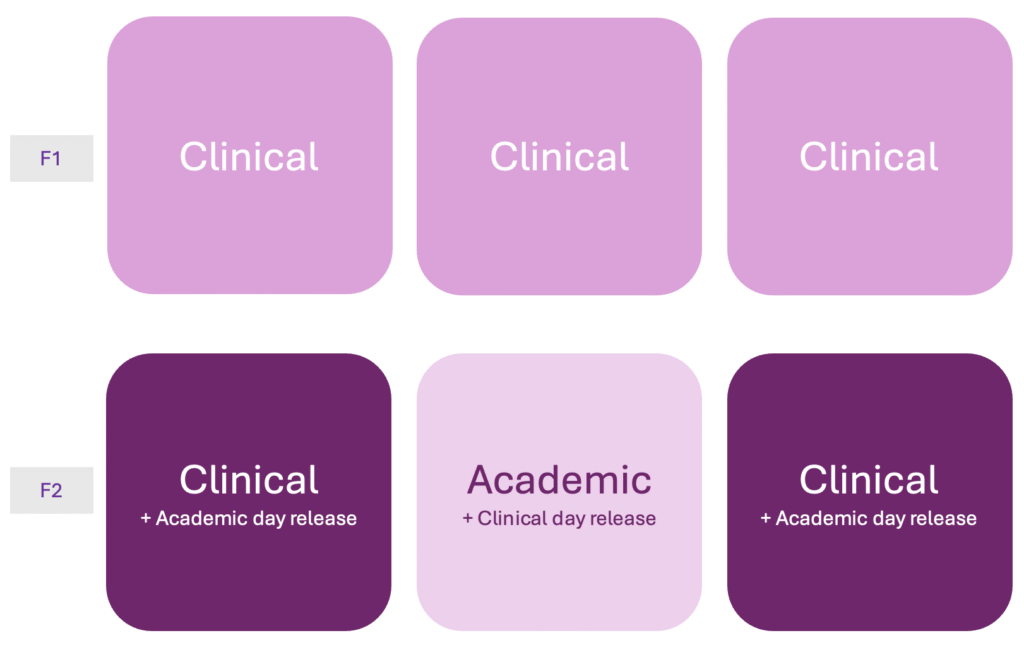
✅Advantages of this structure:
- Good amount of time to work on a project and get something underway without much pressure of clinical work
- Less chance of deskilling over the academic block
- Can keep projects longer than four months going
❌Disadvantages:
- Potential for clinical and academic time to blur, especially during clinical rotations
⚖️Why Consider SFP?
The SFP can provide:
- Early exposure to research, teaching, or leadership which may be in an area of your academic interest.
- Opportunities to publish, present, or teach, which strengthen your CV and can lend weight to a future specialty application.
- Networking opportunities with academics, clinicians, and mentors.
And arguably most importantly, it definitely provides:
- An early chance to gauge how much you enjoy academic or leadership work before committing long-term.
📄Applying to Foundation Jobs
🎯Eligibility
The FP and SFP share identical eligibility criteria, so all final-year UK medical students can apply. Applicants from outside the UK or UK graduates over two years post-qualification will need to submit an eligibility application before making any UK foundation programme application. The deadline for this process is usually in late July, before FP applications open. For more information, applicants should consult the UKFPO website eligibility application pages.
📝The Application
Applications open at the same time as the Foundation Programme, usually in September. You must still apply to the main FP if you apply for an SFP, as the SFP application is processed completely separately to and has no impact on your FP application (which is mandatory). SFP recruitment takes place before the main Foundation Programme allocation. If you accept an SFP post, you are removed from the PIA process. You can apply for both programmes through the UK-wide online system, Oriel. The application consists of:
- Evidence of achievements (such as publications, audits, oral/poster presentations, or prizes)
- ‘Whitespace’ questions (can be skills or motivations based, depends on the deanery)
- An interview, which also varies by deanery (with stations often testing clinical reasoning, motivation, and knowledge of research/teaching/leadership)
⚡Selection process
Each nation of the UK currently has a slightly different approach to managing the selection process. In Scotland and Northern Ireland, local selection processes are held by the foundation schools after they have been allocated. In Wales, all SFPs are allocated using the main allocation system (preference informed). For more details, please refer to the ‘further reading’ section below.
There have been some recent and controversial changes to the SFP allocation system for England last year, so as of August 2025, there are two pathways through which you can be allocated an SFP post.
England SFP Application process
- Pathway 1: Medical school selection
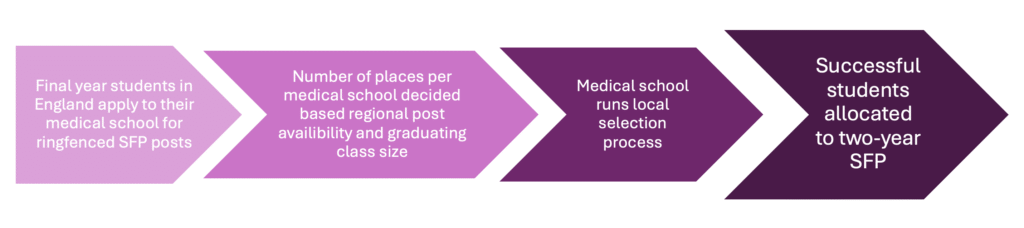
One third of all SFP positions are allocated to current final year students through this pathway. Selection processes are individual to each medical school, and they are also required to arrange an appeals process for decisions through this pathway.
If you are successful and decide to take your SFP offer, you are removed from the FP pool before allocations take place. If not, you remain in the pool and are allocated via the Preference Informed Allocation (PIA) system.
- Pathway 2: PIA
The PIA system is a computerised allocation system via Oriel, where applicants rank their preferred foundation schools. Allocation to foundation posts is then determined based on each applicant’s national ranking and stated preferences.
Two thirds i.e. the rest of the SFP positions are allocated this way. Once the pathway 1 SFP allocations are made, all remaining eligible applicants are given a computer generated random rank. This rank determines the order in which the Oriel algorithm looks at all the applicants. The algorithm uses a ‘two pass’ system which is implemented the same way for allocating foundation schools, matching to groups within schools and/or matching to programmes depending on the school.
In the first pass, first choice allocations are made.
Each applicant is considered according to their assigned rank. If their first-choice school has spaces, they are allocated there. If not, the algorithm skips them and continues down the list.
In the second pass, unplaced applicants are allocated.
The algorithm works through the list of remaining applicants in order, allocating them to their highest preference school that still has places available.
🎯Tips for success
- Get involved in projects early (audits, student teaching, poster presentations). This is a no-brainer to boost this section of your application.
- Keep a portfolio of achievements, projects, and contacts. It is surprisingly easy to forget details in the chaos of med school life.
- Prepare answers using STAR(R) (Situation, Task, Action, Result, + optional Reflection) to help structure responses for both white space questions and interviews.
- Connect with past SFP doctors on platforms like LinkedIn. Personal experience can teach you invaluable lessons which are otherwise inaccessible or hard-learned.
- If applicable, look for student societies and peer-run networks offering SFP preparation support.
💭Is the SFP Right for You?
Ask yourself:
- Do I enjoy research, teaching, or leadership enough to commit time alongside clinical work?
- Am I curious to explore academic or leadership roles early?
- Am I prepared for some extra workload in exchange for new opportunities?
- Can I manage to achieve all my competencies with less clinical time?
If yes, then consider the SFP! Either way, give yourself time to make this decision so you can maximise your application.
The Specialised Foundation Programme is simply one route through foundation training, potentially opening doors to further opportunities in research, leadership, or education. However, there is no restriction on doing research during a standard FP, and not doing an SFP does not exclude you from doing academic work in the future in any way. Whether you apply or not, what matters most is that you leave foundation training as a safe, competent, and compassionate doctor.
📚Resources
- UKFPO website official guidance
- London SFP applicant guide
- NHS England 2025 Specialised foundation programme (SFP) recruitment and allocation guidance
- In depth description of 2026 allocation process
- Local deanery SFP pages – List of Foundation Schools with contact and website details
- Useful explainer video on the whole system
- Informative YouTube series on the SFP
- A day in the life of an SFP doctor – part of a useful series but is from 3 years ago
- Specific information for each UK nation can be found here
- Oriel quickstart guide
Thanks for reading! If you have any comments or suggestions, please feel free to share them below.