

Everything you need to know about Oriel, Foundation Schools, Preference Informed Allocation (PIA), ranking jobs, SFP, FPP, pre-allocation and getting your first job as a doctor.
Applying to the UK Foundation Programme can feel confusing when you first start looking into it.
You suddenly hear people talking about Foundation Schools, Oriel, PIA, groups, programmes, SFPs, FPPs, pre-allocation, placeholders and random rankings, often without anyone properly explaining how it all fits together.
The actual process is much easier to understand once you break it down.
This guide takes you through the whole thing, from submitting your original application to eventually finding out the hospital and rotations you will be working in.
Most importantly, we are going to properly explain Preference Informed Allocation (PIA), because this is the part of the application process that is probably the most important to understand before you start ranking anything.
🩺What is the UK Foundation Programme?
The UK Foundation Programme (UKFP) is the two-year training programme that most newly qualified doctors complete after medical school.
It is designed to bridge the gap between being a medical student and entering specialty or GP training. The programme is split into:
Foundation Year 1 & 2 (F1/F2)
During F1 you begin working as a doctor with supervised responsibility for patient care, you will work under a provisional GMC registration. After successfully completing F1, you will receive your full GMC registration.
During F2 you remain supervised, but generally have more responsibility and independence. You will begin making more clinical decisions yourself and take on a slightly more senior role within the team. Successful completion of F2 gives you your Foundation Programme Certificate of Completion (FPCC), which is normally needed to progress into specialty or GP training.
In a standard foundation programme – you will rotate through 6 different rotations, each lasting 4 months (longer if you choose to work less-than-full-time)
A typical programme might look something like:
F1: Geriatrics – Upper GI Surgery – Gastroenterology
F2: Trauma & Orthopaedics – Psychiatry – Breast Surgery
Another programme could look completely different. LIFT and SFP programmes look slightly different (to be explained later). The exact combination of specialties depends on the Foundation Programme you eventually get allocated.
📅The Foundation Programme timeline
For UKFP 2027, some later dates are still confirmed progressively, but the main timeline looks (roughly) like this:
| Stage | Date |
|---|---|
| UK medical school nomination | 15 September 2026 |
| National application opens | 23 September 2026 |
| UKFPO helpdesk cut-off | 6 October 2026 at 12:00 BST |
| National application closes | 7 October 2026 at 12:00 BST |
| Pre-allocation deadline | 7 October 2026 at 12:00 BST |
| Pre-allocation outcomes | December 2026 |
| Final Foundation School ranking deadline | 10 February 2027 at 12:00 GMT |
| Foundation School allocation | March 2027 (date TBC) |
| Group preferencing | March 2027 (date TBC) |
| Programme preferencing | March – April 2027 (date TBC) |
| Programme allocation | April 2027 (date TBC) |
| Employer checks | Spring and summer 2027 |
| Shadowing and induction | Late July 2027 |
| F1 starts | Start of August 2027 |
Interested in SFP? Some SFP routes have separate/local selection processes, so check your nation and medical school’s guidance early rather than waiting until programme preferencing. For 2027 specifically, England uses local medical-school selection for one-third of SFP posts, while the other two-thirds go through the main FP/PIA process.
🗺️Foundations Schools, Groups and Programmes
Before looking at the application itself, there are three terms you need to understand.
What is a “Foundation School” (or Deanery)?
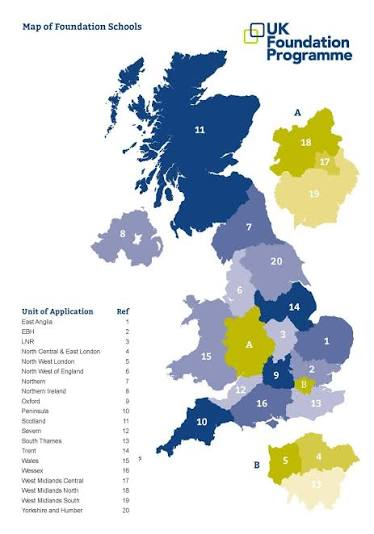
Foundation schools are large geographical areas responsible for Foundation training. The UK is divided into 18 Foundation Schools (or “deaneries”).
NB: Foundation School is the official term, although people often still informally call them deaneries. Click the links below for the google maps location of each area.
- East of England Foundation School – (Cambridge, Norwich, Bedford, Chelmsford, Stevenage)
- Kent, Surrey and Sussex Foundation School (KSS) – (Brighton, Canterbury, Maidstone, Frimley, Guildford, Worthing, Margate)
- Leicestershire, Northamptonshire and Rutland Foundation School (LNR) – (Leicester, Northampton, Kettering, Rutland)
- London Foundation School – (Central London, Croydon, Ealing, Kingston, Lewisham, Ilford, Enfield)
- North West of England Foundation School – (Manchester, Liverpool, Lancaster, Blackpool, Crewe, Southport, Wirral)
- Northern Foundation School – (Newcastle upon Tyne, Durham, Sunderland, Darlington, Carlisle, Northumberland)
- Northern Ireland Foundation School – (Belfast, Antrim, Derry/Londonderry, Newry, Omagh, Downpatrick)
- Peninsula Foundation School – (Exeter, Plymouth, Torquay/Torbay, Truro)
- Scotland Foundation School – (Glasgow, Edinburgh, Aberdeen, Dundee, Inverness, Perth, Dumfries)
- Severn Foundation School – (Bristol, Bath, Gloucester, Cheltenham, Weston-super-Mare, Yeovil)
- Thames Valley Foundation School – (Oxford, Reading, Milton Keynes, Slough, Aylesbury, High Wycombe)
- Trent Foundation School – (Nottingham, Derby, Lincoln, Chesterfield, Burton upon Trent, Boston)
- Wales Foundation School – (Cardiff, Swansea, Newport, Bangor, Wrexham, Aberystwyth, Port Talbot)
- Wessex Foundation School – (Southampton, Portsmouth, Bournemouth, Winchester, Basingstoke)
- West Midlands Central Foundation School – (Birmingham, Solihull, Sutton Coldfield, West Bromwich)
- West Midlands North Foundation School – (Stoke-on-Trent, Wolverhampton, Walsall, Dudley, Shrewsbury, Telford)
- West Midlands South Foundation School – (Coventry, Warwick, Worcester, Hereford, Nuneaton, Stratford-upon-Avon)
- Yorkshire and Humber Foundation School – (Leeds, Sheffield, York, Hull, Huddersfield, Doncaster, Scarborough, Scunthorpe)
FOUNDATION SCHOOLS MAP – this map wasn’t produced by us, and we cannot vouch for its complete accuracy, however it is extremely useful to visualise the different Foundation Schools and the spread of their respective hospitals. Shout out to Ritwick Chatterji for the map!
What is a “Group”?
Most Foundation Schools split their programmes into smaller groups.
These usually represent a smaller geographical area or collection of hospitals. For example, a large Foundation School may contain hundreds of jobs spread across several cities. Instead of ranking every single programme immediately, you may first rank the groups. Once you have been allocated to a group, you then rank the individual programmes within it.
The exact structure differs slightly between Foundation Schools. For example in Wales, the groups are the various health boards across the country such as Cardiff & Vale, Hywel Dda, Betsi Cadwaladr etc. There are 6 groups in Wales for 6 of its health boards. After I was allocated to Wales, I had to rank the 6 groups which would then be subject to the same PIA system. After I was assigned a group (e.g. Cardiff & Vale Health Board) I had to then rank the individual programmes offered by my health board (i.e. pick my favourite group of 6 specialties/rotations).
What is a “Programme”?
Your programme is the actual two-year job that you eventually receive.
This tells you things such as:
- Which hospitals you will work in
- Which specialties you will rotate through (usually 6)
- Which F1 rotations you will have (usually 3)
- Which F2 rotations you will have (usually 3)
- Sometimes which trust or health board will employ you
Once you are allocated a programme – that’s the end of the application process! Your Foundation School might contain hundreds of different programmes, all with different combinations of locations and specialties.
💻Applying through Oriel
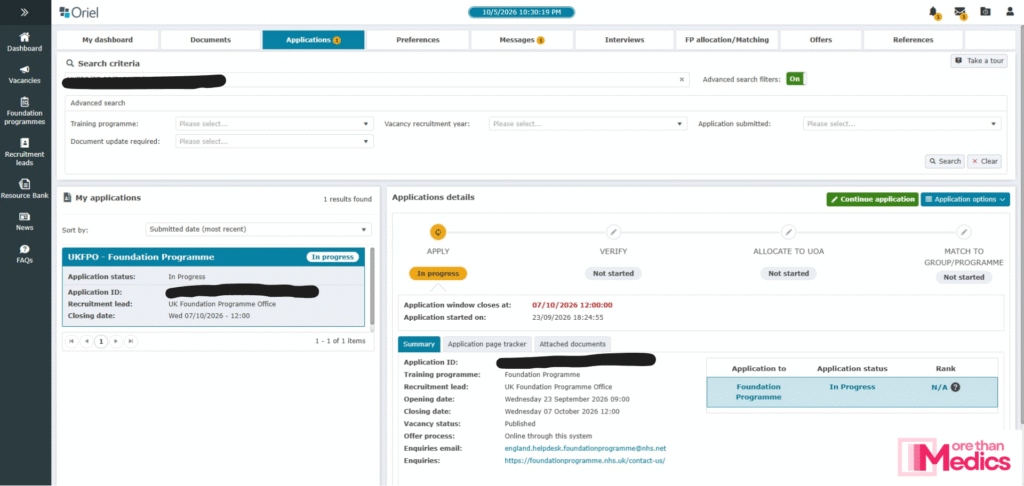
Foundation Programme applications are completed through Oriel. Oriel is the national online application system used for postgraduate medical training in the UK.
For most UK medical students, your medical school will “nominate” you for the Foundation Programme – this means they’ll automatically register you on Oriel for you to apply. For UKFP 2027, nomination emails for UK medical students were sent on 15 September 2026.
You will normally receive an email allowing you to access the correct Oriel account and complete your application.
The main Foundation Programme application window runs from: 23 September 2026 to 7 October 2026 at 12:00 midday BST
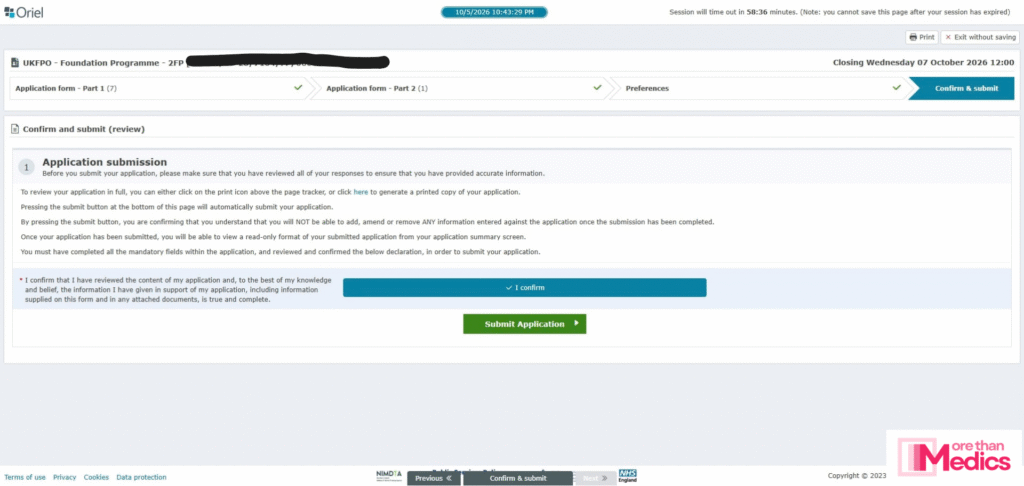
Starting your application is not enough. You need to have actually submitted it before the deadline. Late applications are NOT accepted – the UKFP are very strict about this so absolutely under no circumstances leave this too late.
IMPORTANT: the Foundation School rankings you enter when applying in October are not final. You can continue changing their order until 10 February 2027 at 12:00 GMT. You therefore do not need to have perfected your rankings before submitting the main application – just make sure your provisional rankings are done, and the application itself is submitted by the October deadline.
📝What do you need to Apply?
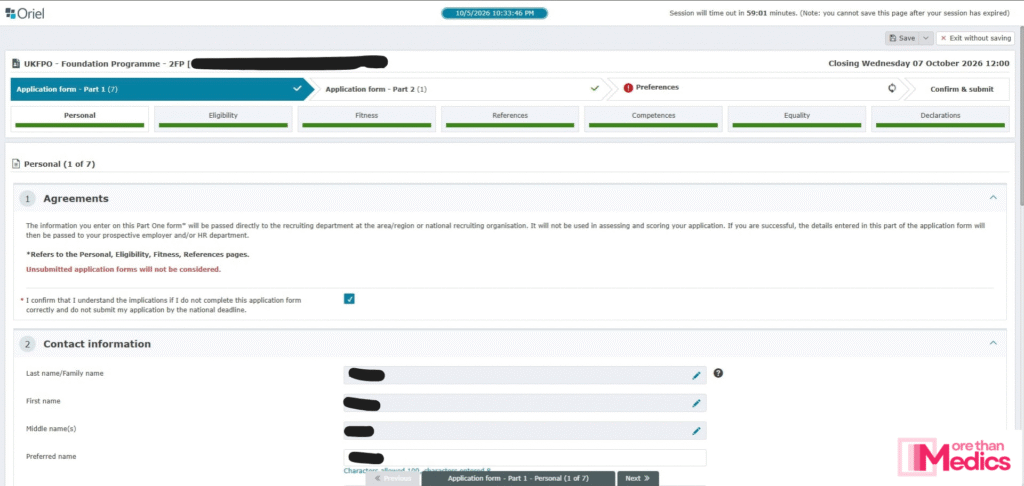
The application itself is not like applying to university or applying for specialty training. You are not writing a personal statement or uploading publications / prizes. No SJT (Situational Judgement Test) anymore. Instead, the Oriel application contains sections covering things such as:
- Part 1
- Personal details
- If you want to work LTFT.
- GMC number (will be emailed to you beforehand)
- Right to work in UK
- Fitness to practise
- Academic reference – choose an appropriate referee from your medical school who knows your performance. The reference does not affect your PIA rank or allocation, so don’t overthink it.
- Primary medical qualification
- Equality monitoring
- Declarations
- Part 2 – Pre-allocation and Linked applications
- Part 3 – Foundation School preferences (provisional preferences, finalise by February)
For most UK medical students, much of this is fairly straightforward administrative information. Just make sure you confirm & submit by 7 October 2026 at 12:00 midday BST.
Foundation Programme Pre-allocation
Some applicants have personal circumstances that mean they genuinely need to remain in a particular geographical area – this is where pre-allocation may apply to you.
For UKFP 2027, the national categories include:
- Parent or legal guardian
- Primary carer
- Health condition or disability
- Extraordinary circumstances
- Widening participation
You need to read the specific UKFPO criteria carefully if you think you might qualify.
The eligibility criteria and evidence requirements for pre-allocation are very strict and stringent. For example, pregnancy alone does not automatically qualify someone under the parent or legal guardian criterion.
Pre-allocation also usually only secures your Foundation School. It does not automatically guarantee your preferred hospital, city, group or programme.
For UKFP 2027, the pre-allocation deadline is: 7 October 2026 at 12:00 BST
If you think you might qualify, investigate this early. Do not leave it until the night before the application deadline because supporting evidence may be required.
Linking Foundation Programme applications
Two applicants can also request to link their Foundation Programme applications.
This is designed for people who want to try to stay within the same Foundation School. Both applicants need to rank Foundation Schools in the same order.
There is an important catch. The linked pair is effectively considered using the lower-ranked applicant’s PIA rank.
So if one person gets an excellent computer rank and the other gets a much lower one, linking will mean you are allocated according to the lower-ranked person’s rank.
There are also circumstances where the link can be broken, including certain pre-allocation or specialised programme situations.
If you are considering linking applications, both people should understand exactly how it works before choosing it.
Local allocation schemes
There are also local allocation schemes in parts of England, Scotland and Wales. These can allow some applicants to receive Foundation Programmes through locally organised processes. The details vary depending on the medical school and country. Even if you are involved in a local allocation scheme, you still normally need to complete the national Foundation Programme application through Oriel. Check/liaise with your own medical school to see whether this applies for you or not.
📊How Competitive is each Foundation School?
UKFPO publishes historical data showing how many applicants ranked each Foundation School first compared with how many programmes were available. This gives you something called a first-preference ratio.
The number of Foundation Programme places varies considerably between regions. These figures change between application cycles. They are useful for understanding the rough size of each Foundation School.
The first-preference ratios (and 2026 number of places) were as follows:
| Foundation School | 2026 FP places | 2026 ratios | 2025 ratios | 2024 ratios |
|---|---|---|---|---|
| East of England | 921 | 0.71 | 0.65 | 0.47 |
| Kent, Surrey and Sussex (KSS) | 703 | 0.85 | 0.96 | 0.63 |
| Leicestershire, Northamptonshire and Rutland (LNR) | 330 | 0.75 | 0.72 | 0.53 |
| London | 1,216 | 2.04 | 1.78 | 2.42 |
| North West of England | 1,081 | 1.14 | 1.35 | 1.35 |
| Northern | 568 | 0.76 | 0.94 | 0.82 |
| Northern Ireland | 387 | 0.79 | 0.85 | 0.66 |
| Peninsula | 319 | 0.88 | 0.87 | 0.65 |
| Scotland | 1,237 | 1.08 | 1.01 | 1.00 |
| Severn | 421 | 1.32 | 1.22 | 1.68 |
| Thames Valley Oxford | 342 | 1.29 | 1.64 | 1.42 |
| Trent | 474 | 0.54 | 0.47 | 0.50 |
| Wales | 460 | 0.66 | 0.65 | 0.57 |
| Wessex | 437 | 0.59 | 0.60 | 0.51 |
| West Midlands Central | 286 | 1.39 | 1.11 | 1.35 |
| West Midlands North | 436 | 0.40 | 0.38 | 0.39 |
| West Midlands South | 294 | 0.52 | 0.54 | 0.45 |
| Yorkshire and Humber | 898 | 0.78 | 0.86 | 0.71 |
A ratio above 1 means there were more first-choice applicants than places. A ratio below 1 means there were fewer first-choice applicants than available places.
For example, London’s 2026 ratio of 2.04 meant it had more than twice as many first-choice applicants as available programmes. Wales had 0.66 first-choice applicants per available place, meaning it was not oversubscribed on first-preference demand in that year’s primary allocation.
These figures are useful for understanding how popular a Foundation School has historically been, and can give you a rough indication of historical demand/oversubscription.
🧭Factors to look at when choosing a Foundation School?
You will need to rank all of the Foundation Schools in order of preference. Before formally ranking them, you need to properly figure out what your individual priorities are. It can be easy to be subconsciously steered by other people’s thinking, but decide what matters most to you.
1. Geography & Commutes
Do not choose a Foundation School based on the city you associate with its name – many cover huge areas, so ranking North West for Manchester or Wales for Cardiff could still mean being placed somewhere completely different within that region.
- Which cities are covered and how large is the geographical area?
- How are groups divided within each Foundation School?
- Where could you realistically end up?
- Where are the hospitals – how far apart are they? Is it commutable?
- Would you need a car? How would you get around?
- Where would you live? Some deaneries/health boards have free accommodation for F1 (like Wales!). Could you stay at your own home?
- Would you potentially have to move house between F1 and F2?
- Is there an airport nearby for national/international travel? (really handy for quick holidays!)
2. Hospitals & Working Environment
Look at the actual hospitals within each Foundation School. You might care about:
- Teaching hospitals
- District general hospitals
- Tertiary centres
- Rural hospitals
- Major trauma centres
- Specialist centres
A Foundation School might contain several completely different working environments.
3. Specialties & Specialised Programme
Look at which specialties appear within the programmes. If you are particularly interested in something like:
- Dermatology
- Cardiology
- Paediatrics
- Emergency Medicine
- Psychiatry
- Intensive Care
- Anaesthetics
- Neurosurgery
- Ophthalmology
Then search through the programmes on Oriel and see how many programmes the given specialty appears in for a certain Foundation School. For instance if you want dermatology → look at how many programmes actually include dermatology, where they are based and if the rotation is during F1 or F2.
Also certain Foundation Schools host certain specialised programmes such as the Specialised Foundation Programme (SFP) & Longitudinal Integrated Foundation Training (LIFT). These programmes are explained further down this article. These programmes are generally very desirable and sought after, so it’s worth ranking them highly if you are interested in them yourself.
4. Rota intensity, support and teaching quality.
Try to look beyond the specialty names and find out what working there is actually like day to day. Useful things to ask current Foundation Doctors about include how intense the on-call rota is, how well staffed the wards are, whether seniors are approachable, how easy it is to get help when you are stuck, and whether protected teaching actually happens in practice. A slightly less glamorous programme with good supervision, manageable rotas and strong teaching can often make for a much better F1 experience.
5. Accommodation & Cost of living
This is easy to ignore when applying. Your F1 salary is broadly similar wherever you work, but the cost of rent can vary hugely. The lifestyle you can afford in central London will obviously be different from what the same salary buys in parts of Wales, the Midlands or Northern England. Ask yourself questions like – would I rather a better living standard & higher disposable salary or would I rather work in a bigger city, more prestigious hospital, with potentially more opportunities nearby?
If you really think this through it could dramatically change where you pick.
6. Family, partner and friends
Foundation training lasts two years. Being close to people you care about may matter more than having one particular rotation. This is something worth thinking about properly:
How far would you want to be from family? How close would you like to be to your friends? How far would you be willing to travel to see your partner?
The answer to these questions can often be the deciding reason for many.
7. Social Life
Think about what day-to-day life will actually be like outside the hospital. Some Foundation Schools are centred around large cities with lots of restaurants, nightlife, gyms, sports clubs and other young professionals, while others are more rural or spread across several smaller towns. It is also worth thinking about how easy it is to meet other Foundation Doctors, and whether you are happy living somewhere quieter if the hospital or rotations are otherwise a good fit.
8. Career Opportunities
Different Foundation Schools can offer very different opportunities outside your normal clinical rotations. Look at access to teaching, research, audits and QI, leadership roles, conferences, university links, specialist centres and departments related to careers you may be interested in. If you already have a specialty in mind, it may also be useful to consider whether the region has strong departments, academic units or tertiary centres in that area, as these can make it easier to find mentors, projects and relevant experience for future specialty applications.
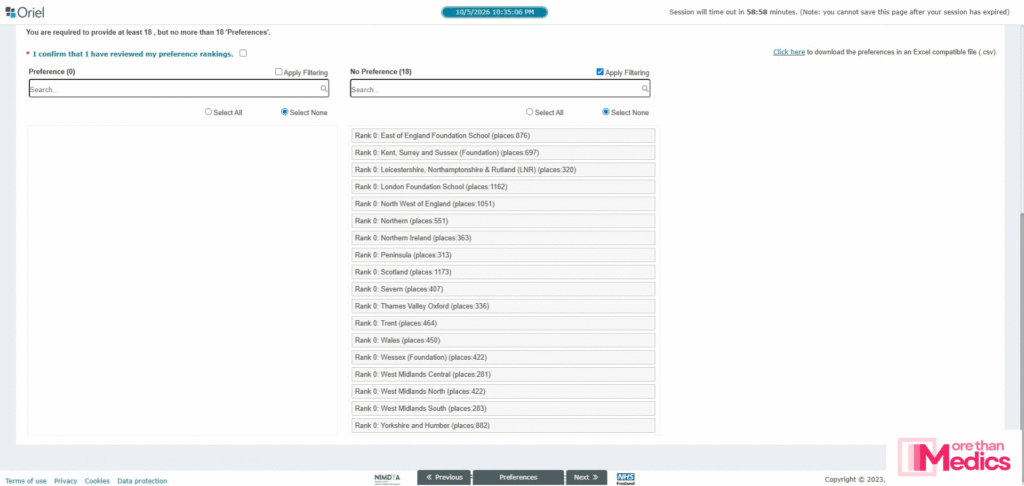
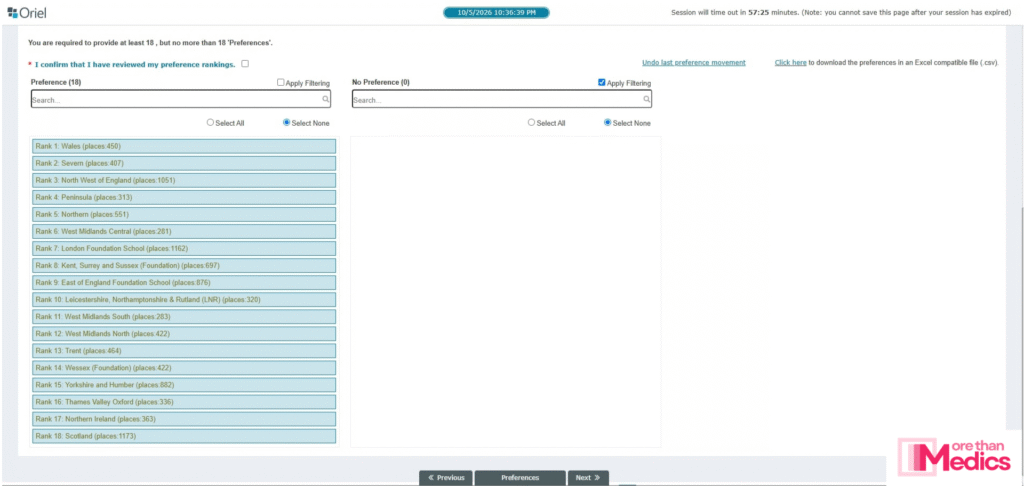
NB: Ensure you drag ALL the Foundation Schools to the “Preference” column, even if you don’t like a given Foundation School – don’t leave any in the “No Preference” column.
The same page will be available to rank your allocated Foundation Schools’ groups, and then when the time comes, the individual programmes within your allocated group. NB: there may be hundreds of programmes to rank on the right “No Preference” column to individually rank in the left “Preference” column.
🎲Preference Informed Allocation (PIA)
Preference Informed Allocation, usually shortened to PIA, is the system used to allocate Foundation Programme applicants. PIA was introduced from the 2024 Foundation Programme after concerns that the old medical school performance and SJT-based system was stressful, inconsistently standardised and could create unfair differences between applicants.
Following a 2023 national stakeholder consultation with more than 14,500 responses, 84% of whom were medical students → 66% supported moving to PIA. Thus, UKFPO moved to PIA to create a simpler, less competitive process designed to maximise the number of applicants receiving their first-choice Foundation School.
In practice, however, satisfaction with the PIA system has been mixed. Subsequent surveys have reported widespread concerns around perceived fairness, loss of control over allocation and the removal of performance-based measures. First-choice allocation rates have also not clearly improved compared with the previous system, while some applicants report significant personal and wellbeing impacts from being allocated largely by chance.
Your attainment in medical school, supra-curricular achievements, and proof of interest in specialties, all make no difference to the location or job rotations you’ll eventually get. This guide was created to help give you the best possible chance of getting the location/specialties that you want. So let’s see how you can do that.
In the standard Foundation Programme route, PIA is used to allocate your Foundation School and, where applicable, your group and programme – so it is important to understand how it works.
How PIA works
Now we get to the bit that everyone should properly understand before ranking Foundation Schools – how PIA works:
Every eligible applicant receives a computer-generated rank.
To put this into a real-world context, in UKFP 2026 there were a total of 11,752 applicants, each of which were RANDOMLY assigned a computer-generated rank from 1 to 11,752. If you were extraordinarily lucky you got #1, and if you were frightfully unlucky you got #11,752 – it’s all up to chance.
You do not choose this rank and there is nothing you can do to determine it – it is truly random. Also, rather crucially, you are not aware of this rank – you don’t know it. You’ll only be told of your rank well after the application process is finished (long after it is ever useful).
My own eventual rank was #9,584 out of 11,752 – numerically around the lower fifth of all generated ranks. However, the raw number does not perfectly represent your position amongst the applicants actually competing with you, because withdrawn and non-priority applicants may be skipped during allocation, while pre-allocated applicants and certain SFP applicants can be dealt with separately.
So when ranking Foundation Schools, groups and programmes, you are effectively trying to make the best decisions you can without knowing your exact position.
This same rank is used THROUGHOUT the application process for Foundation School allocation, Group allocation, and Programme allocation – your original assigned rank persists through each application round. So I remained rank #9,584 through all 3 allocation stages. The system uses your rank alongside your preferences, to assign you a deanery, group, and eventually a programme. The allocation happens in two passes. We’ll explain it below…
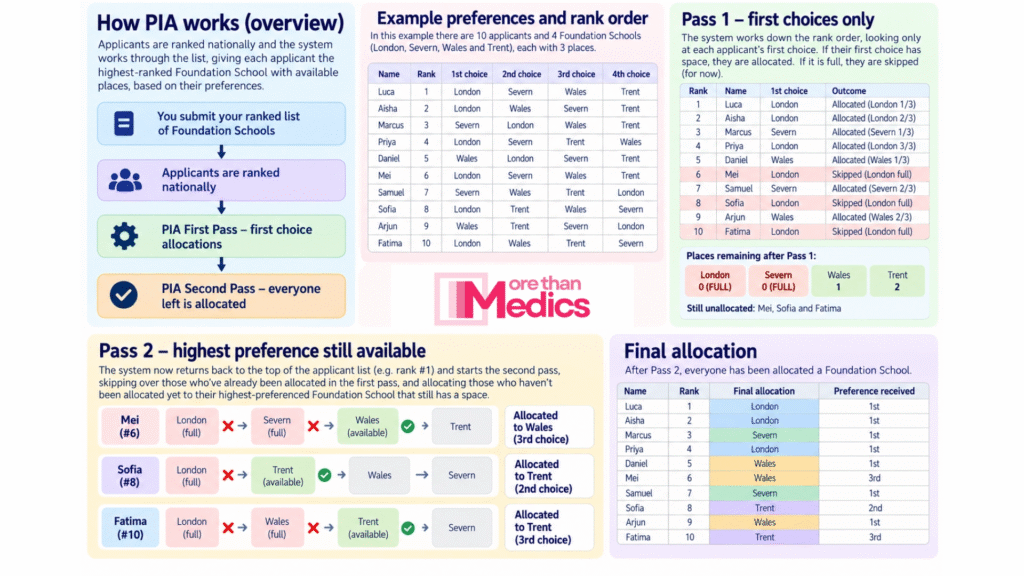
PIA Pass 1 Explained- first choices only
The system begins with the highest-ranked applicant e.g. the person with the rank #1.
It asks: “Is there still a place available in this person’s first-choice Foundation School?“
If yes → they get their Foundation School. If no → they are skipped over (no allocation yet), and the system moves onto the next candidate and asks yet again: “Is there still a place available in this person’s first-choice Foundation School?“
If yes → they get their Foundation School. If no → they are skipped over (no allocation yet), and the system moves onto the next candidate.
It keeps doing this all the way through the applicant list.
The important part is what happens when someone’s first choice is already full. They are skipped. The system does not immediately look at their second choice. It continues through everybody else and keeps trying to allocate people to their first choice.
PIA Pass 2 Explained- everyone who did not get allocated
Once the system has gone through the entire applicant list once, it returns back to the top ranked person and starts a second pass:
If any given individual has already received a Foundation School in the first pass, they are skipped over (as they already have a place!) until the system reaches a candidate who’s not allocated yet.
This time, it looks down that candidates preference list and asks: “What is the highest-preferenced Foundation School on this candidate’s list that still has a space?“
That candidate is allocated the Foundation School that is highest up on their list, that still has a place.
The system then continues through the remaining applicants, allocating the highest preference still available until the available places for that allocation round have been filled. For most UK medical graduates this happens as part of the main allocation; non-priority applicants may instead remain on the national reserve list, as explained later.
🔢Simple PIA Example with 10 Applicants
Imagine there are only four Foundation Schools: London (3 places), Severn (2 places), Wales (3 places), Trent (2 places).
And imagine there are only 10 applicants: Aisha, Daniel, Sofia, Arjun, Mei, Samuel, Fatima, Luca, Priya, Marcus.
Each applicant ranks their preferences from 1 to 18. Each applicant is randomly assigned a rank from #1 to #10.
Their ranks and preferences look like this:
| Name | Rank | 1st choice | 2nd choice | 3rd choice | 4th choice |
|---|---|---|---|---|---|
| Luca | 1 | London | Severn | Wales | Trent |
| Aisha | 2 | London | Wales | Severn | Trent |
| Marcus | 3 | Severn | London | Wales | Trent |
| Priya | 4 | London | Severn | Trent | Wales |
| Daniel | 5 | Wales | London | Severn | Trent |
| Mei | 6 | London | Severn | Wales | Trent |
| Samuel | 7 | Severn | Wales | Trent | London |
| Sofia | 8 | London | Trent | Wales | Severn |
| Arjun | 9 | Wales | Trent | Severn | London |
| Fatima | 10 | London | Wales | Trent | Severn |
Now let’s run PIA.
Pass 1 Example
The system starts with the highest-ranked applicant and works down the list, looking only at each person’s first choice.
- Luca (#1) ranks London first. London has space (3 spaces left), so Luca gets London.
- Aisha (#2) also ranks London first. London still has space (2 spaces left), so Aisha gets London.
- Marcus (#3) ranks Severn first. Severn has space (2 spaces left), so Marcus gets Severn.
- Priya (#4) ranks London first. She takes the final London place (1 space left), so London is now full.
- Daniel (#5) ranks Wales first. Wales has space (2 spaces), so Daniel gets Wales.
- Mei (#6) ranks London first, but London is already full. Therefore she is skipped.
- Importantly, the system does not immediately check her second choice, Severn. It simply moves on to the next applicant.
- Samuel (#7) ranks Severn first. He takes the final Severn place (1 space left), so Severn is now full.
- Sofia (#8) ranks London first. London is full (0 spaces left), so she is skipped.
- Arjun (#9) ranks Wales first. Wales still has space (2 spaces left), so he gets Wales.
- Fatima (#10) ranks London first. London is full, so she is also skipped.
At the end of Pass 1:
| Foundation School | Places remaining |
|---|---|
| London | 0 (FULL) |
| Severn | 0 (FULL) |
| Wales | 1 |
| Trent | 2 |
The applicants still waiting are Mei (#6), Sofia (#8) and Fatima (#10).
Pass 2 Example
The system now goes back to the highest-ranked applicant who is still unallocated.
- Mei (#6)
- Her preferences are: London → Severn → Wales → Trent
- London is full. Severn is full. Wales still has one place.
- So Mei gets Wales, her third choice.
- Sofia (#8)
- Her preferences are: London → Trent → Wales → Severn
- London is full. Trent still has space.
- So Sofia gets Trent, her second choice.
- Fatima (#10)
- Her preferences are: London → Wales → Trent → Severn
- London is full. Wales is now full after Mei was allocated there. Trent still has space.
- So Fatima gets Trent, her third choice.
The final allocation looks like this:
| Name | Rank | Final allocation | Preference received |
|---|---|---|---|
| Luca | 1 | London | 1st |
| Aisha | 2 | London | 1st |
| Marcus | 3 | Severn | 1st |
| Priya | 4 | London | 1st |
| Daniel | 5 | Wales | 1st |
| Mei | 6 | Wales | 3rd |
| Samuel | 7 | Severn | 1st |
| Sofia | 8 | Trent | 2nd |
| Arjun | 9 | Wales | 1st |
| Fatima | 10 | Trent | 3rd |
The most useful comparison here is Mei and Samuel.
Mei had the better rank at #6, while Samuel was #7. Mei ranked Severn second, but Samuel ranked Severn first.
Because Pass 1 considers everyone’s first choice before any second choices, Samuel was able to take the final Severn place during Pass 1.
By the time Mei was considered again during Pass 2, Severn was already full.
That is the key quirk of PIA to understand.
🎯Ranking Strategy: Foundation Schools
Take into account the factors listed above in creating a list in your mind of your most preferred Foundation Schools in order. Then comes the strategy…
Your first-choice Foundation School matters disproportionately under PIA. As the example above shows, a lower-ranked applicant can sometimes take a place ahead of you simply because they ranked that Foundation School first and you ranked it lower.
That means choosing your first preference is really a balance between ambition and security. If one Foundation School is clearly your favourite, it can make sense to put it first and take your chance. But if your top two or three choices are quite close, it is worth looking at historical first-preference ratios and asking whether you would rather use your first-choice advantage on a school you would still be very happy with and which has historically had lower first-choice demand. UKFPO itself notes that outcomes depend heavily on applicant behaviour in that particular year, so historical ratios should guide your thinking rather than be treated as guaranteed probabilities.
When ranking Foundation Schools, ask:
Would I rather take my chance at my absolute favourite Foundation School, even if that gives me a greater chance of dropping further down my list, or would I rather prioritise somewhere I would still be very happy living?
That is the real decision PIA creates. It can be a really tough choice.
You may hear advice from people who’ve been through the process – some may err on the side of caution and say “it’s not worth it to go for London” and others may say “go for it!”. It’s important you make this decision for yourself. Advice you hear from others will undoubtedly be dictated by what they find important, their risk-taking comfort, and their own experience with PIA. If they applied and got London they’ll be more likely to advise you to go for it, and vice versa. It’s important to gauge your decision off of your individual preferences and needs, the likely first-choice application ratios, and your individual willingness to take a risk.
After your first choice is decided, it becomes much simpler – rank the remaining Foundation Schools in the exact order you would genuinely want them. If your first choice is unavailable, PIA will work down your preference list and allocate you to the highest option that still has a space, so there is little benefit in trying to strategically reorder your lower choices based on perceived competitiveness.
📍Ranking Strategy: Groups
Getting your Foundation School is only the first allocation. Most Foundation Schools then ask you to rank groups. Currently, all English, Welsh and Scottish Foundation Schools use groups; Northern Ireland does not use groups. PIA is used again to allocate you to a group, after which you rank the individual programmes within it.
For example if you are allocated the Wales Foundation School – your groups will be:
Aneurin Bevan, Betsi Cadwaladr, Cardiff and Vale, Cwm Taf Morgannwg, Hywel Dda and Swansea Bay.
Ranking your groups
Imagine your Foundation School contains five geographical groups.
You might rank them:
- Group A
- Group B
- Group C
- Group D
- Group E
The same basic two-pass PIA process is then used. Once your group is confirmed, you move on to ranking individual programmes.
Some groups are very popular, some are very unpopular.
For example: in the Wales Foundation School, generally the most competitive group is Cardiff & Vale (capital city with a prestigious teaching hospital and good transport links). The least popular group is generally Hywel Dda (rural, smaller towns, further away from the rest of the country, poor transport links, less prestigious hospitals)
For group ranking, it is worth speaking to friends, students at local medical schools within your allocated Foundation School. Better still, current F1s and/or F2s in that Foundation School. They will often have useful insider knowledge that is difficult to get from official programme documents alone, such as which hospitals have a good reputation for support and teaching, what the rota and on-call burden is like, how easy commuting is, whether parking is a nightmare, where Foundation Doctors tend to live, how social each hospital is, how well staffed the wards are, and which sites or rotations are generally popular or unpopular.
Group Selection Psychology
Another thing to bear in mind is that group popularity can swing quite dramatically from year to year, partly because applicants react to the previous year’s competition ratios. A group that looked very competitive one year may attract fewer first-choice applicants the next because people decide to “play it safe” elsewhere. Equally, a group that looked less competitive may suddenly become much more popular.
This happened in Wales in my application year. Cardiff & Vale had looked highly competitive the year before, and from speaking to other students, many seemed put off and were considering strong alternatives such as Aneurin Bevan or Cwm Taf instead. I took the opposite view and ranked Cardiff & Vale first, partly because I thought that previous year’s high ratio might actually reduce demand in my year.
You obviously cannot predict applicant behaviour with certainty, but understanding how other applicants may respond to historical ratios can add another layer to your first-choice strategy. Use the numbers as a guide, but also consider the psychology behind them rather than assuming last year’s most competitive group will automatically be the most competitive again.
Can you estimate your PIA rank from your allocation?
Although you are not told your actual PIA rank at this stage, your Foundation School allocation can give you a very rough clue. Look at which Foundation Schools you ranked above the one you received, how competitive those schools historically were, and how far down your list you fell.
However, be careful not to overinterpret this. Your allocation is only a signal, not a reliable way of calculating your rank. In my case, I ranked Wales 7th after several highly competitive Foundation Schools and was allocated Wales. At the time, I thought my rank could still potentially have been quite strong, with the schools above Wales simply filling before I reached them. When UKFPO eventually released the numbers, my actual rank was 9,584 out of 11,752.
You can still use this information strategically. If your allocation suggests your rank may be weaker, you might choose to use your first-choice advantage on a group you genuinely like but which has historically been less competitive, rather than risking falling much further down your list for the “best” and most competitive group. Conversely, if you think your rank may be stronger, or one group is clearly your favourite, you may be more willing to take the chance on a competitive first choice.
Also remember that once you reach group allocation, you are no longer competing against the entire national applicant pool – you are competing against the applicants allocated to your Foundation School. The distribution of ranks within that group may therefore look very different from the national distribution. This is impossible to know precisely, but it is another useful factor to consider.
For example, I was allocated to Wales Foundation School. My thinking was that, on average, the pool of applicants allocated to Wales might contain a greater proportion of lower-ranked applicants than the national cohort. This was based on the fact that Wales historically has relatively low first-preference demand, meaning some applicants who eventually receive Wales may have ranked it much lower and only been allocated there after missing out on several higher preferences. This was only a hypothesis, not something I could know for certain, but combined with my rough estimate of where my own rank might sit, it influenced my decision to take a chance on the relatively competitive Cardiff & Vale group – which I ultimately received.
The point is not that you can calculate your rank accurately, but that you can use your previous allocation, historical demand and a rough idea of the applicant pool you are now competing against to judge how much risk you want to take with your next first preference. It is still educated guesswork, but it can help you decide whether to chase the most competitive group or use your first-choice advantage on a slightly safer option you would still be happy with.
After your first-preference is ranked, rank the other groups in the order you would genuinely want them, taking into account things like location, commute, available rotations, hospital culture, teaching quality, rota intensity, accommodation, social life and access to specialties you are interested in
📋Ranking Strategy: Programmes
This is where things can get time-consuming. There can be around 100 programmes to preference in order – that is quite time (and brain power) consuming!
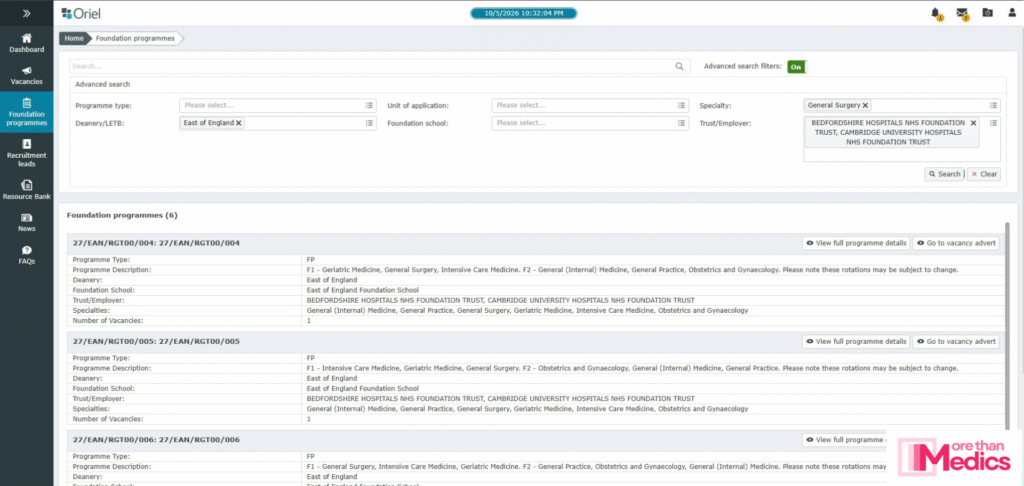
A programme (listed in your Foundation Schools’ big excel file) might look something like:
“WAL/FP26/045a – Cardiff & Vale University Health Board – F1: General (Internal) Medicine / Geriatric Medicine – UHW, General Surgery / Upper Gastro-intestinal Surgery – UHW, General (Internal) Medicine / Gastroenterology – UHW | F2: Trauma and Orthopaedic Surgery- UHL, General Psychiatry – UHL, General Surgery / Breast Surgery – UHL.”
That’s really confusing I know – let’s break it down.
- “WAL/FP26/045a” is just the name/identifier of the given programme.
- “Cardiff & Vale University Health Board” is the health board or group within which the programme exists
- “General (Internal) Medicine / Geriatric Medicine – UHW” means geriatrics block based at UHW hospital.
NB: on-call shifts may not be in the same hospital as your given rotation. Different health boards will list things differently.
NOTE: you may find multiple programmes containing the same six rotations but in a different order. Do not assume these are identical – the order determines which specialties you do in F1 versus F2 and at what point in your training. For example:
- Job WAL/FP26/045a may have: Gastro, Cardio, Resp, ICU, Paeds, GP (in that order)
- but job WAL/FP26/045b may have: Cardio, Gastro, ICU, Resp, Paeds, GP
- and job WAL/FP26/045c may have: Cardio, GP, Resp, ICU, Paeds, Gastro
Supernumerary jobs
Some rotations are supernumerary, meaning you are additional to the core staffing rather than being relied upon to keep the service running. In practice, this often means more senior supervision, less independent responsibility and sometimes fewer or no on-calls – although you will still clerk/review patients, do jobs, procedures and contribute to the team. F1 paediatrics and ICU are common examples of rotations that can be supernumerary, but this varies a lot by hospital, so check the actual job description or ask current trainees rather than assuming.
Whether that is a good thing depends on you. Some people love the lower workload and chance to learn in a very supported environment; others prefer jobs where they get more independence and responsibility. Also, supernumerary does not necessarily mean poor learning – some of these jobs can actually offer excellent teaching, procedures and senior exposure because you are less tied down by service provision.
Ranking tip: find out whether each rotation is genuinely supernumerary, whether you join the on-call rota, and what previous F1s actually spent their days doing.
F1 vs F2 rotations
Do not just look at which specialties a programme contains – look at when you do them. The same specialty can feel very different in F1 compared with F2 because F2s are expected to take increasing responsibility, make more management decisions and work with more indirect supervision.
For example, you might prefer paediatrics or ICU in F1 if the post is supernumerary and you want exposure in a highly supported environment. Alternatively, you might prefer ED or GP in F2, when you have already spent a year developing your assessment and decision-making skills and may feel more comfortable dealing with undifferentiated patients. That said, there is no universally “best” year for a specialty – doing ED early may accelerate your acute skills, while doing it later may let you get more out of the added responsibility.
So when comparing programmes, ask yourself:
“Do I want this rotation – and do I want it at this point in my training?”
A programme with six great specialties can still be less attractive if the rotations you care about most fall in an order that does not suit how you want to develop.
What is a placeholder programme?
If you are allocated a placeholder programme, you have secured a place within your Foundation School, but you do not yet know your exact hospital, employer or two-year rotation. You will usually find this out later in the recruitment cycle, once the Foundation School has been able to finalise where the remaining applicants will be placed. UKFPO guarantees that applicants who have been allocated to a Foundation School will ultimately receive a two-year Foundation Programme.
In practice, spaces can become available because another applicant withdraws or gives up an allocated programme, or because the Foundation School is able to confirm additional training capacity later on. This does not necessarily mean you are getting a “bad programme” that nobody else wanted – some perfectly good programmes become available simply because somebody’s circumstances change. If existing programmes are not available, the Foundation School still has to ensure its placeholder applicants are given a confirmed programme, which may involve arranging additional posts locally. Note: This may (or may not) be a supernumerary post – this may be alluring for some people.
The biggest downside is the uncertainty. You may know which Foundation School you are going to but not which city, hospital or rotations you will have until considerably later than other applicants. That can make sorting accommodation, commuting and general life plans difficult. UKFPO specifically advises placeholder applicants not to commit to accommodation until their final programme and employer have been confirmed.
A simple programme ranking spreadsheet
You may have dozens or even hundreds of programmes to rank. Trying to do this manually inside Oriel can be painful. One useful approach is to export the programme information and organise it in a spreadsheet.
You could create a table that has columns like this:
| Programme code | Programme details (F1/F2 rotations + locations) | Location score | Rotations score | Red Flag? | Total score | Notes |
|---|
Go through each programme and give it a location score out of 10, and a rotations score out of 10. A good way of indicating that a programme has an absolute deal-breaker is marking it with a red flag – then when you preference you can put red flags to the bottom of your list in order of bad to worst. You could then weight each column to your preference, and create an equation to compute a final score. This can give you a semi-objective measure of each programme which then you can use rank your jobs.
AI can be utilised effectively for some of these steps – but be careful, I wouldn’t entrust 2 years of your life to a generative AI output. Just be careful and double check AI outputs if you use it!
Of course this table is rather basic – but it is a useful concept which you can tailor for yourself. You may add columns and categories that are relevant to you and personalise this scoring system to your Foundation School and group, and your individual needs.
Programme ranking strategy
When thinking about programme ranking strategy, here are some important factors to keep in mind:
- By the time you reach programme preferencing, you now have two previous allocation outcomes to learn from – the Foundation School you received and the group you received. Together, these may give you a slightly better feel for how competitive your rank has been within the pools you have competed in. For example, getting your first-choice group despite receiving a lower Foundation School preference may make you more comfortable taking a chance on a competitive programme. However, this is still only educated guesswork. You do not know the other applicants’ ranks or preferences, and demand can change considerably each year. Use your previous outcomes as another piece of information, not as a reason to override the order you genuinely prefer the programmes.
- The same first-choice PIA principle applies when ranking programmes.
- You could pick a good programme with an obvious (but not serious) flaw – others may be quick to discard this programme making it less competitive and thus your chances of getting it are higher.
- An additional layer of strategy to get a highly competitive programme, is to pick the worst variant of a set of 6 rotations – that way you potentially pick the least competitive arrangement of a highly competitive programme. However people may genuinely perceive your “worse” programme as better, and double bluffs may occur here too.
- If you want SFP/LIFT programmes – rank them highly
- Ensure you’re aware of the locations of each of your ranked specialties – a rank #4 can suddenly become a rank #90 if you find out that 3/6 specialties are in a far off distant hospital.
Once your programme is confirmed, your Foundation School and employing organisation will contact you about the practical steps before starting work. This normally includes references, occupational health, right-to-work and employment checks, GMC registration and local induction paperwork. Your employer will then provide information about contracts, rota arrangements and mandatory shadowing/induction before F1 begins.
🔬Specialised Foundation Programme (SFP)
The Specialised Foundation Programme, or SFP, is designed for people who want extra experience alongside normal clinical Foundation training.
Depending on the programme, this may involve areas such as:
- Research
- Medical education
- Leadership
- Management
The exact structure varies. Some programmes may include protected academic time. Others may have a dedicated academic rotation or longitudinal academic component. Every particular SFP works in a different way. Do your own research to try figure out what that may look like.
For instance some of my colleagues get a day a week, for a whole year, to work on research. This is paid the same as a normal working day, but you can spend it at home. Pretty amazing.
SFP is usually highly sought after, so for SFP posts allocated through the main FP process, rank them highly if you want one.
How SFP applications currently work
The exact process differs between England, Wales, Scotland and Northern Ireland.
In England, some SFP places are selected locally through medical schools, while other SFP places are included within the main Foundation Programme allocation process and allocated using PIA.
Even if you are applying through a local SFP selection route, you still need to submit the normal national Foundation Programme application.
In Wales, SFP programmes are included within the main Foundation Programme process and allocated through PIA.
Scotland and Northern Ireland have their own arrangements.
If you are interested in an SFP, check both the national guidance and your medical school’s information early.
Do not rely on old information found online (including this article if/when it becomes outdated!), because SFP recruitment has changed significantly in recent years, and will likely continue to do so.
⭐Foundation Priority Programmes (FPP)
Foundation Priority Programmes, or FPPs, are Foundation jobs designed to encourage applicants to apply to programmes in certain geographical areas that historically receive fewer applications. Generally speaking, people tend to prefer bigger cities than very rural areas.
Benefits that an FPP may offer may include:
- Financial incentives
- Accommodation support
- Postgraduate qualifications
- Leadership opportunities
- Medical education
- Research
- Rural medicine
- Digital health
- Quality improvement
- Enhanced specialty exposure
Some of these programmes can be very attractive. They are definitely worth checking rather than assuming an FPP is simply a job nobody wants.
For UKFP 2027, there is no longer a completely separate national FPP application process. FPP jobs are included within the main Foundation Programme allocation.
🔄Longitudinal Integrated Foundation Training (LIFT)
LIFT stands for Longitudinal Integrated Foundation Training.
Normally, Foundation rotations happen in blocks. E.g. you might spend four months doing Psychiatry and then leave Psychiatry completely when the rotation finishes.
A longitudinal programme works differently. You may continue working within a particular specialty or setting across a longer period while completing your other Foundation rotations. E.g. you may spend one day a week in a GP Practice for the whole of F1 whilst on the other days you do your normal rotations.
Different LIFT programmes work differently. Examples of LIFT programmes can be in areas such as:
- General Practice
- Psychiatry
- Community medicine
If you like the idea of following patients or working with a specialty over a longer period, these programmes are worth looking into for your given Foundation School, and Group. They are usually highly sought after, so rank them highly during the programme preferencing stage if you want to do LIFT.
⏳Less Than Full-Time (LTFT) Foundation training
Foundation training can also be completed less than full time. You can indicate on your application that you are interested in LTFT training.
This can be tremendously useful for those with other life commitments outside of foundation training whether that be another occupation/job, family/caring responsibilities, or maybe you just fancy a bit more free time. Note your salary will be proportional to the amount of work you do.
You may want to do this at 80% (4 working days a week on average) or 60% (3 working days a week on average), or another arrangement. You can finalise the arrangements later with your Foundation School. However if you know you want to do LTFT, it may streamline things to do it early in your initial application form.
If you think LTFT might be appropriate for you, contact the relevant Foundation School early so that the practical arrangements can be discussed.
🌍International Medical Graduates (IMGs)

The application process is more complicated for doctors graduating outside the UK.
There are several separate things you need to think about:
- Foundation Programme eligibility
- UKFP prioritisation
- GMC registration
- PLAB where required
- English language requirements
- Visa and Right to Work
- Whether you have already completed an internship
The Eligibility Office for international applicants
Most international applicants need to apply through the UKFP Eligibility Office before they can submit the main Foundation Programme application.
For UKFP 2027, the Eligibility application window ran from: 1 July to 22 July 2026
This is much earlier than the main September Foundation Programme application.
This is one reason international students need to start researching the process well in advance.
Internship and GMC registration
One of the biggest things international graduates need to understand is the difference between provisional and full GMC registration.
F1 is designed for doctors who are eligible for provisional GMC registration.
If you have already completed an internship that the GMC considers sufficient for full registration, you may not be eligible to complete the standard two-year UK Foundation Programme.
This can become complicated because internship structures differ between countries.
Some international medical schools also require graduates to complete an internship before their medical degree is considered fully complete.
If you are an international applicant, check your own situation directly against GMC guidance.
Do not assume that because somebody from another country could apply to F1, your circumstances will automatically be the same.
PLAB
Many international graduates need to complete the PLAB exams as part of becoming eligible for GMC registration.
The timing matters because Foundation Programme Eligibility applications happen early.
Depending on when your medical school finishes and when PLAB dates are available, some international applicants may end up with a gap between graduating and starting Foundation training.
If that happens, people sometimes use the time for things such as:
- PLAB preparation
- Clinical attachments
- Observerships
- Research
- Teaching
- Quality improvement
- Other healthcare work
Again, check the exact registration pathway that applies to you rather than assuming PLAB is required in every situation.
English language requirements
International applicants may also need to demonstrate English language proficiency.
Accepted routes can include:
- An eligible Primary Medical Qualification taught in an appropriate English-speaking country
- IELTS
- OET
For UKFP 2027 Eligibility applications, the requirements included high minimum scores across every individual component, rather than simply an overall score.
The exact accepted test dates and required scores can change between application cycles.
If you are planning to apply in a future year, use the UKFPO guidance for that specific cycle rather than relying on numbers from an old article.
You do not necessarily need to already hold your eventual working visa when you initially submit your Foundation Programme application.
Visa requirements
Applicants who require visa sponsorship can indicate this during the process.
Once you have been allocated a Foundation Programme and employer, the employer can provide the sponsorship information required for the relevant visa route.
Doctors commonly use the Health and Care Worker visa.
Immigration rules can change, so always check the current Home Office guidance.
A major change – prioritisation of Foundation Programme applicants
Anyone applying now also needs to understand the changes introduced by the Medical Training (Prioritisation) Act 2026.
Priority for Foundation Programme allocation is now given to eligible UK graduates and certain other defined groups before other eligible applicants.
This means there is an important difference between: being eligible to apply and being in a priority group for allocation.
You could meet the Foundation Programme eligibility requirements but still be considered a non-priority applicant.
For Foundation Programme purposes, prioritisation is mainly linked to where you obtained your Primary Medical Qualification, rather than simply your nationality.
Current priority groups include qualifying medical graduates from places including:
- United Kingdom
- Ireland
- Iceland
- Liechtenstein
- Norway
- Switzerland
What happens to non-priority applicants?
Eligible non-priority applicants can still apply to the Foundation Programme, but prioritisation affects when they may be allocated.
At the main allocation, priority applicants are allocated first. If there are still enough programmes available, some non-priority applicants may also be allocated at this stage, with their computer-generated rank determining who is allocated first.
For context, in UKFP 2026, 11,752 applicants were given computer-generated ranks, while 10,810 priority applicants were allocated to a Foundation School on national allocation day. Applicants who had withdrawn or were non-priority were skipped during the main allocation, meaning the raw computer-generated rank does not necessarily equal an applicant’s effective position within the active priority pool.
Any non-priority applicants who are not allocated remain on the national reserve list. Further allocation rounds then take place if vacancies become available, for example when another applicant withdraws. Reserve-list applicants are allocated using PIA, their existing computer-generated rank and their Foundation School preferences.
Therefore, being eligible to apply does not necessarily mean you will receive a Foundation School at the main allocation. If you are a non-priority applicant, you should be prepared for the possibility of remaining on the reserve list while waiting for later vacancies.
⚠️Common Mistakes when applying to the Foundation Programme
- Missing the application deadlines – the biggest avoidable mistake. Do not plan to submit your application at 11:55 on deadline day. Submit it early.
- Leaving pre-allocation too late – if you think you may qualify for pre-allocation, check the criteria and start gathering evidence early, as the requirements are strict and the deadline comes with the main application.
- Not thinking about the geography properly – a Foundation School does not mean just one city. Always investigate the whole geographical area.
- Ignoring groups – your preferred Foundation School might contain one group you love and another that is several hours away. Understand the group structure.
- Trying to reverse-engineer your exact PIA rank from your allocation – your Foundation School and group outcomes can give you clues, but applicant behaviour, competition, skipped applicants and the two-pass system mean you cannot reliably calculate your rank from them.
- Choosing a programme because of one rotation – one exciting four-month rotation might not compensate for five other rotations you hate. Look at the whole programme.
- Ignoring where/when the specialty occurs – if you want a particular specialty, check whether it appears in F1 or F2. The experience can be very different.
- Treating historical preference ratios as definite probabilities– the first-choice ratio is useful information. But use it in context, understanding that these ratios are volatile year on year.
- Not understanding PIA – only if you understand it correctly will you be able to effectively rank your preferences.
- Not putting enough importance on the first choice – the best way of getting a space over someone who has a better rank than you.
- Following old SFP or FPP advice – both processes have changed in recent years. Make sure the advice you are reading applies to your application year and always check with the primary sources such as the UKFP website.
- Forgetting to save your preferences – don’t assume Oriel has automatically saved everything you changed. Check properly before closing the page.
- Assuming your medical school grades affect your allocation – under PIA, academic performance does not determine your Foundation Programme rank; applicants are given a computer-generated rank.
😌Finally – Don’t Stress!

Take the time to properly understand the process and research your options. Two years can feel like a long time when you are choosing where to live and which rotations you will do, and those choices can shape the people you meet, the opportunities you come across and even what you end up becoming interested in afterwards.
At the same time, don’t get lost trying to find the “perfect” ranking – it doesn’t exist. You can research carefully and preference intelligently, but PIA still involves a large element of chance. Once you have made the best decisions you can with the information available, try not to obsess over every tiny difference between programmes.
And if you don’t get what you hoped for, don’t panic. Two years pass quickly, and a programme that initially feels disappointing can turn out to have great people, unexpected opportunities and advantages you could never have predicted from an Oriel spreadsheet. Where you are allocated matters, but what you make of those two years matters just as much. I was initially incredibly distraught with my allocation, but I’ve realised its been an absolute blessing in disguise – if you get “unlucky” I’m sure you’ll find a way to get the most out of it.
Best of luck – hopefully you get exactly what you want, but if you don’t, it won’t define the rest of your career. I hope you enjoyed this article and found it useful. I wrote it as I found the process quite stressful myself, and felt there wasn’t enough clear guidance on it. Thanks for reading and welcome to the beginning of your life as a doctor (it’s really fun!).
DISCLAIMER: This article is intended as a practical guide to the UK Foundation Programme. Application dates, eligibility requirements and recruitment processes can change between years. Always check the latest UKFPO, Oriel, GMC and Home Office guidance before applying.
A special thanks to Michelle Diamond for the Oriel Screenshots!
🔗 Official UKFP Guidance & Useful Links
This guide is designed to make the process easier to understand, but always check the official guidance for your application year before making any decisions or submitting anything. The most useful official resources are:
- UK Foundation Programme (UKFPO) main website – the best starting point for national guidance, application processes and updates. UK Foundation Programme
- UKFP 2027 Application Timeline – official dates and deadlines. UKFP 2027 Timeline
- Oriel – where you submit your application and preferences. Oriel
- How to Apply on Oriel – official step-by-step guidance for completing each part of the application. UKFPO Oriel Application Guidance
- Foundation Schools – official information and links to each of the 18 Foundation Schools. Use the individual Foundation School websites for local programmes, hospitals and rotations. Foundation Schools
- Foundation School Preferencing – how to rank, save and amend your preferences in Oriel. Foundation School Preferencing Guidance
- First-Preference Ratios – official historical Foundation School demand and competition data. UKFPO First-Preference Ratios
- Pre-allocation – criteria, evidence requirements and application guidance for applicants who need to remain in a particular geographical area. UKFP Pre-allocation Guidance
- Specialised Foundation Programme (SFP) – current national guidance and links to nation-specific selection arrangements. SFP Guidance
- Eligibility & International Applicants – guidance for applicants who need to apply through the UKFP Eligibility Office. UKFP Eligibility Guidance
- UKFP Prioritisation – current guidance on priority and non-priority applicants, allocation and the reserve list. UKFP Prioritisation FAQs
- GMC Provisional Registration – what UK graduates need to do before starting F1. GMC Provisional Registration Guidance
Our Article on SFP
Our Article on Less than Full Time




One Response
This is the first breakdown of the Foundation Training application process I’ve seen that explains everything so clearly! I finally feel like I understand how the PIA system works. Smashing stuff — I’d love to see more in this series about the transition from medical student to doctor. Thanks!!